
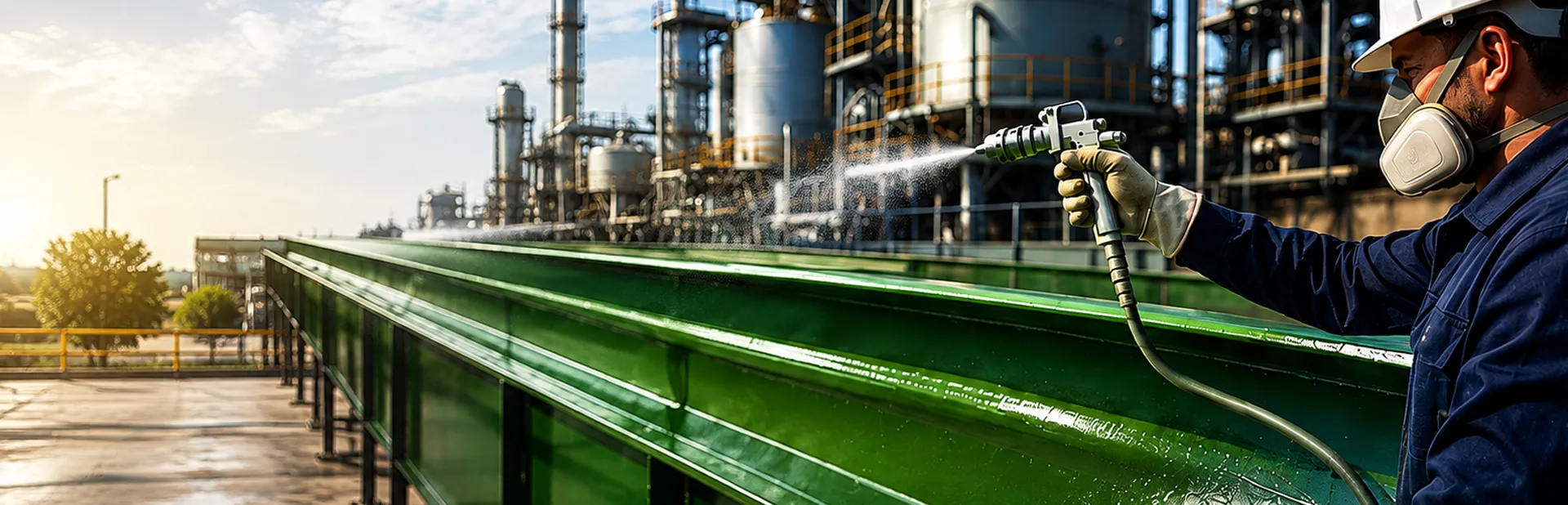

LOW-VOC COATINGS:
COMPLIANCE WITHOUT LOSING DURABILITY
Discover how low-VOC coatings help meet environmental regulations without compromising durability and industrial protection.
WHAT ARE VOCS AND WHY DO THEY MATTER?

VOCs are chemical compounds that evaporate easily at room temperature. In certain industrial processes, they form part of the solvents used to manufacture and apply paints and coatings.
When released into the atmosphere, certain VOCs can contribute to the formation of ground-level ozone and issues related to air quality.
WHY IS INDUSTRY MIGRATING TOWARD LOW-VOC COATINGS?

Greater Regulatory Pressure: Stricter environmental regulations require lower emissions.

Reduction of Environmental Impact: Lower emissions improve air quality and support sustainability goals.

Better Working Conditions: Reducing solvent usage can help decrease worker exposure to certain compounds.

Technological Evolution: Modern coatings deliver high performance with lower emissions.
THE MAIN CHALLENGE: REDUCING VOCS WITHOUT SACRIFICING DURABILITY
Durability depends on multiple factors, including:
- Resin type
- Pigments used
- Surface preparation
- Film thickness
- Application method
- Curing time and conditions
- Chemical exposure
- Temperature
- Humidity
- UV radiation
- Corrosive environment

TECHNOLOGIES DRIVING THE TRANSITION

Waterborne Coatings: Use water as the primary vehicle instead of large quantities of organic solvents.

High-Solids Coatings: Higher proportion of non-volatile material to achieve film thickness with less solvent.

Epoxy Coatings: Excellent adhesion, and chemical and mechanical resistance for demanding environments.

Polyurethanes: Provide durability, abrasion resistance, and resistance to environmental exposure.
SURFACE PREPARATION REMAINS ESSENTIAL
Switching to a low-VOC coating will not solve issues resulting from poor surface preparation.
Operations may include:
- Removal of grease and contaminants
- Abrasive blast cleaning
- Rust removal
- Anchor profile control
- Moisture verification

A properly prepared surface improves adhesion and reduces the risk of premature delamination.
HOW TO CHOOSE A LOW-VOC SYSTEM

Exposure Environment: Indoor vs. outdoor, chemicals, moisture, UV, marine, etc.

Required Level of Resistance: Abrasion, impact, chemicals, moisture, temperature, UV, corrosion.

Application Method: Brush, roller, or various spray systems.

Film Thickness: Adequate thickness ensures durability and prevents defects.
ENVIRONMENTAL COMPLIANCE: BEYOND CHOOSING PAINT

- Identify Applicable Regulations for each facility.
- Review Technical Data Sheets and analyze VOC content.
- Evaluate the Complete System (primer, intermediate, topcoat).
- Validate Performance with pilot tests or trial applications.
- Train Personnel on proper application.
BENEFITS FOR BUSINESSES
 Lower emissions of specific pollutants
 Better alignment with environmental regulations
 Process modernization and efficiency
 Stronger sustainability strategies

THE TRANSITION TO LOW-VOC COATINGS
CONCLUSION
The transition to low-VOC coatings represents an important step toward a more sustainable and responsible future for the coatings industry. By reducing volatile organic compound emissions while maintaining protection, durability, and attractive finishes, these solutions can help industries meet evolving environmental expectations without sacrificing performance.
For companies looking for modern architectural and decorative paint solutions, Sylpyl USA and Decorplastik™ offer a wide variety of products and resources to explore. Visit Decorplastik.com to discover their product lines and find more useful information about paints, coatings, applications, and industry trends.