

The paint industry is undergoing a profound transformation driven by two major global forces: environmental sustainability and the circular economy.
Introduction to Industrial Coatings
For decades, paint manufacturing relied primarily on virgin raw materials derived from petroleum and on processes with a significant environmental impact. However, today many companies are innovating to reduce waste, reuse materials, and create more environmentally friendly products.
One of the most interesting trends is the development of recycled paints, manufactured from recovered resins, sustainable pigments, and reused materials. This innovation not only reduces the environmental footprint of the industry but also aligns with Corporate Social Responsibility (CSR) policies that many large companies are adopting.
In this article, we will explore what recycled paints are, how they are produced, and why they represent a key opportunity for the future of the sector.
The Circular Economy Applied to the Paint Industry
The circular economy proposes a different model from the traditional production system. Instead of extracting, producing, and discarding, it aims to reuse, recycle, and regenerate materials within the production cycle.
In the paint industry, this translates into several strategies:
- Recovery of recycled resins and polymers
- Reuse of leftover or expired paints
- Development of sustainable or natural-origin pigments
- Use of recyclable or reusable packaging
- Reduction of volatile organic compounds (VOC)
This approach helps reduce waste generation and decrease dependence on fossil-based raw materials.
What Are Recycled Paints?
Recycled paints are products that incorporate recovered or reprocessed raw materials into their formulation. These materials can come from various sources, such as industrial surplus, post-consumer waste, or recycled materials from other sectors.
Recycled components may include:
- Recovered resins
- Reused pigments
- Regenerated solvents
- Recycled mineral fillers
Thanks to advances in chemical technology and quality control, these paints can offer properties similar to—or even better than—traditional paints.
Innovation in Recovered Resins
Resins are one of the main components of any paint because they act as the “binder” that fixes the pigment to the surface.
Traditionally, many resins are derived from petrochemicals. However, current innovation is enabling the development of more sustainable alternatives.
Types of Sustainable Resins
1. Recycled Plastic Resins
Some manufacturers are transforming plastic waste into polymers that can be used in paint formulations.
2. Bio-based Resins
These are developed from vegetable oils, natural resins, or biomass.
3. Resins Recovered from Industrial Processes
Chemical residues are purified and reprocessed so they can be reused.
This approach helps reduce dependence on petroleum and decrease the carbon footprint of the final product.
Sustainable Pigments: Color with Lower Environmental Impact
Pigments are responsible for the color and opacity of paints. However, some traditional pigments require extraction or manufacturing processes with significant environmental impact.
For this reason, many companies are developing sustainable pigments.
Examples of Eco-Friendly Pigments
- Pigments derived from natural minerals processed with low environmental impact
- Pigments obtained from industrial by-products
- Plant-based organic pigments
- Pigments recycled from construction waste
In addition to reducing environmental impact, these pigments can also help lower the toxicity of paints.
Recycled Paints and Corporate Social Responsibility (CSR)
Large companies are increasingly integrating Corporate Social Responsibility (CSR) policies into their operations. These policies aim to balance economic growth with social and environmental impact.
Sustainable paints have become an important element within these strategies.
Reasons Companies Adopt Recycled Paints
- Compliance with environmental regulations
- Improvement of corporate reputation
- Reduction of carbon footprint
- Compliance with sustainable building certifications
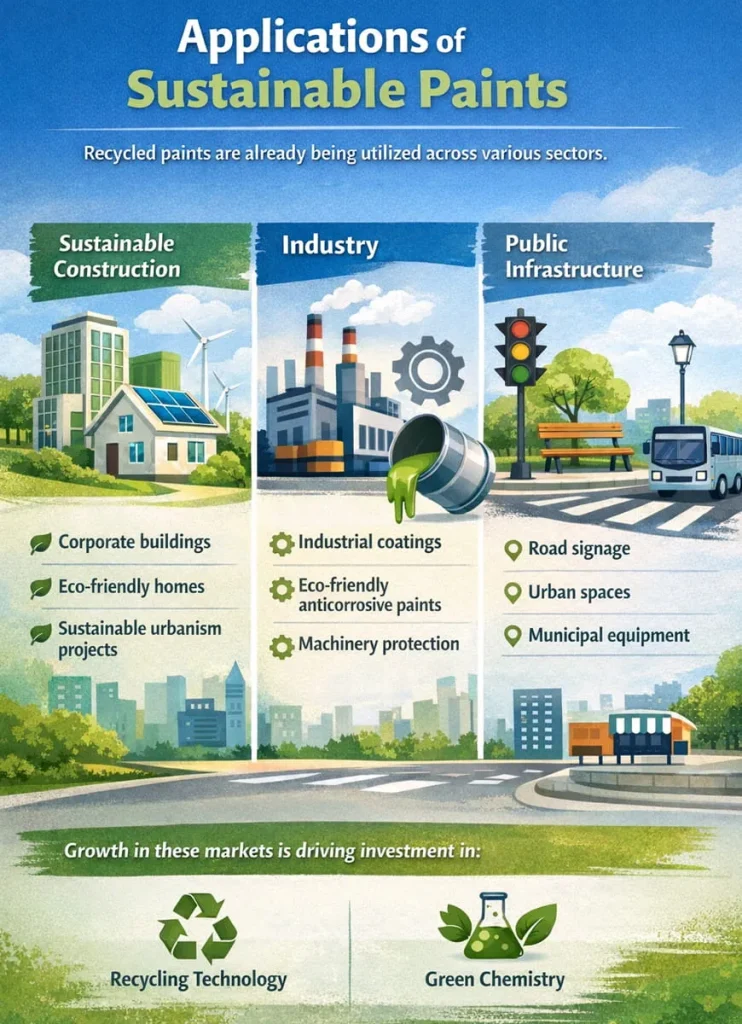
In construction projects, for example, the use of eco-friendly paints can contribute to certifications such as:
- LEED
- BREEAM
- WELL
These certifications are increasingly valued by investors and consumers
Current Challenges of Recycled Paints
Although recycled paints offer significant benefits, they also face several challenges.
Quality Control
It is essential to ensure that recovered raw materials maintain consistent properties.
Market Perception
Some customers still associate the term “recycled” with lower quality.
Scalability
Not all recycling processes are optimized for large-scale production.
However, research and development continue to advance rapidly in this field.
The Future of the Paint Industry
Sustainability has become a global priority, and the coatings industry is no exception. In the coming years, we will see advances such as:
- Paints with certified recycled content
- 100% circular coatings
- Production processes with carbon-neutral emissions
- New green chemistry technologies
Companies that adopt these innovations will be able to position themselves as leaders in a market increasingly aware of environmental impact.
Conclusion
Recycled paints represent one of the most promising innovations in the coatings industry. By reusing resins, sustainable pigments, and recovered materials, it is possible to manufacture high-performance products with a lower environmental impact.
This approach not only contributes to the circular economy, but also responds to the growing sustainability demands of customers, governments, and large corporations. In a context where Corporate Social Responsibility (CSR) is becoming increasingly important, sustainable paints are emerging as a key tool for building a more responsible industrial future.